
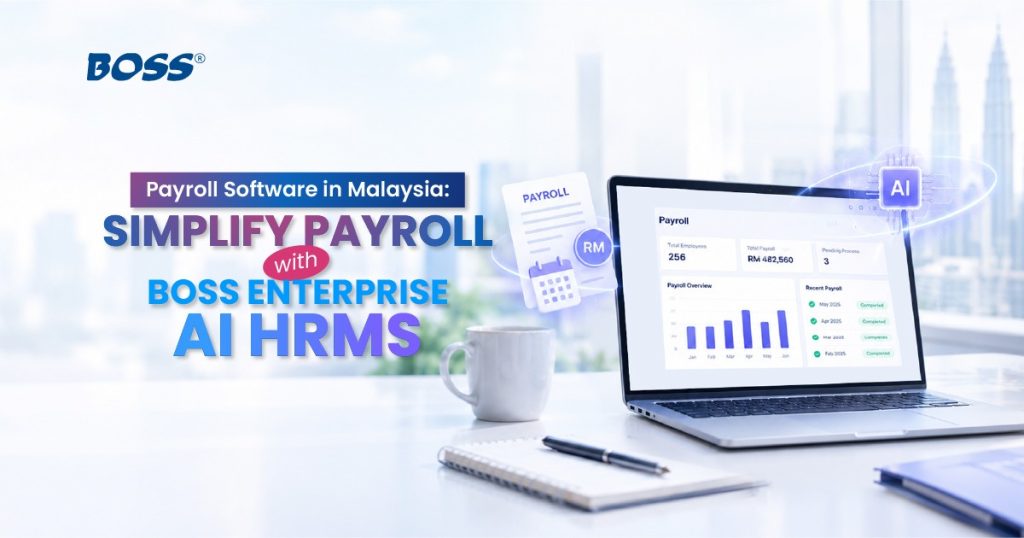
Managing payroll accurately and efficiently is essential for every business. From calculating employee salaries and overtime to managing statutory contributions and generating payslips, payroll processing involves multiple tasks that require accuracy, consistency and careful record management.
For Malaysian businesses, payroll software helps automate salary calculations, streamline payroll administration and support statutory reporting requirements. By connecting payroll with other human resource functions, companies can reduce repetitive administrative work, improve data consistency and manage their workforce more efficiently.
BOSS Enterprise AI HRMS provides an integrated HR management solution designed to help Malaysian businesses streamline payroll and workforce management. With payroll, time and attendance, leave management, employee self-service and other HR functions available within one platform, businesses can build a more connected and efficient HR operation.
What Is Payroll Software?
Payroll software is a digital system that helps businesses calculate employee salaries, manage earnings and deductions, process payroll records and generate payslips and payroll reports. Depending on its features, payroll software can automate recurring payroll calculations, incorporate attendance and overtime information, support statutory calculations and simplify payroll documentation.
Unlike manual spreadsheets, an integrated payroll system can connect employee information, attendance records, leave data and compensation details, reducing the need to enter the same information across multiple systems.
For Malaysian businesses, payroll software may support the administration of:
Employee salaries and wages: Basic salary, allowances, overtime and other applicable earnings.
Statutory contributions and deductions: EPF, SOCSO, EIS and Monthly Tax Deduction (PCB/MTD), according to applicable requirements.
Payroll records and payslips: Employee salary statements, payroll summaries and historical records.
Payroll reporting: Information to support payroll reviews, reconciliation and financial administration.
HR integration: Connections between payroll, employee records, attendance, leave and other HR processes.
The right payroll software helps HR and finance teams manage recurring payroll tasks with greater consistency while maintaining appropriate review and approval procedures.
Why Do Malaysian Businesses Need Payroll Software?
As a company grows, payroll becomes more complex. Additional employees, different salary structures, shift arrangements, overtime claims and changing employee information can increase the workload for HR and finance departments. Relying on spreadsheets and manual calculations can also make it more difficult to identify discrepancies and maintain consistent records.
Here are five reasons Malaysian businesses should consider implementing payroll software.
1. Improve Payroll Accuracy
Manual payroll processing involves repeated calculations and data entry, increasing the risk of errors in salaries, allowances, deductions and overtime. Payroll software helps automate supported calculations and consolidate employee payroll information. This allows payroll teams to spend less time on repetitive work and more time reviewing exceptions before salary processing is finalised.
2. Simplify Malaysian Payroll Administration
Employers must manage payroll in accordance with applicable Malaysian employment and statutory requirements. Payroll software can help organise employee payroll information, support relevant statutory calculations and generate payroll reports or files, depending on the system’s capabilities. Businesses should confirm that their chosen provider supports the latest applicable requirements and verify any necessary statutory approvals or calculation compliance.
3. Save Time on Monthly Payroll Processing
Payroll processing often requires HR teams to collect attendance data, verify overtime, update employee changes, calculate deductions and prepare payslips. Automating supported tasks helps reduce repetitive administration and makes monthly payroll workflows more manageable.
4. Strengthen Payroll Record Management
A centralised payroll system helps businesses maintain organised employee salary records, payroll summaries and historical information. With appropriate access permissions and security controls, authorised personnel can retrieve relevant records more efficiently while limiting access to sensitive payroll data.
5. Connect Payroll with Other HR Functions
Payroll does not operate independently of the rest of HR. Attendance, leave, claims, employee information and compensation changes can all affect payroll preparation. An integrated HRMS connects these processes, helping reduce duplicate data entry and discrepancies between different records.
What Features Should You Look for in Payroll Software in Malaysia?
Choosing payroll software involves more than comparing prices. Businesses should assess whether the system can support their workforce structure, payroll requirements, reporting needs and future growth.
Important features include:
Automated payroll calculations
The system should support relevant salary components, deductions, overtime calculations and statutory calculations applicable to the organisation.
Statutory reporting support
Look for relevant reports, files and documentation to support payroll administration and applicable reporting obligations.
Time and attendance integration
Attendance and overtime information should be accessible to payroll teams without unnecessary manual re-entry.
Employee self-service
Employee self-service features can allow employees to access payslips and manage supported HR requests through a digital platform.
Payroll reports and auditability
Payroll summaries, historical records and appropriate approval controls help organisations review payroll results and investigate discrepancies.
Data security and access control
Payroll contains sensitive personal and financial information. Evaluate the provider’s security measures, access permissions, data protection practices and backup and recovery arrangements.
Scalability and HRMS integration
Businesses should consider whether the system can support their employee headcount, organisational structure and broader HR requirements as they expand.
How Does BOSS Enterprise AI HRMS Simplify Payroll Management?
BOSS Enterprise AI HRMS brings payroll together with other HR functions, helping organisations manage employee information and workforce administration through a connected platform. Established in 1990, BOSS Enterprise Solutions has more than three decades of experience in HR technology and serves businesses across multiple industries in Malaysia. Its integrated HRMS approach helps organisations connect payroll-related activities with attendance, leave, employee records and other HR processes.
1. Integrated Payroll and Employee Information
Accurate payroll depends on reliable employee information. BOSS Enterprise AI HRMS provides a centralised approach to HR and employee data management, helping HR teams manage relevant employee information alongside payroll operations. This reduces dependence on disconnected spreadsheets and helps teams maintain greater consistency across HR processes.
2. Time and Attendance Management
Attendance records, overtime and shift arrangements can affect payroll calculations, particularly in manufacturing, retail, hospitality and other industries with shift-based workforces. BOSS Enterprise AI HRMS integrates time and attendance management with broader HR processes, helping organisations manage attendance information and payroll-related workflows more efficiently. Depending on the configured system and applicable rules, businesses can use attendance information to support payroll preparation and verification.
3. Leave and Claims Management
Employee leave and claims administration can create additional work when information is maintained separately from the main HR system. BOSS Enterprise AI HRMS includes leave and claims management capabilities, helping organisations manage employee requests and approval workflows within their wider HR operations. Connecting these processes with employee records can improve visibility and reduce repetitive administration.
4. Employee Self-Service for Greater Convenience
Employees frequently need access to payslips, leave balances, claims and personal employment information. BOSS Enterprise AI HRMS offers Employee Self-Service (ESS) capabilities that allow employees to access supported HR information and perform selected tasks digitally. This can reduce routine enquiries to HR teams while giving employees a more convenient way to manage their HR needs.
5. AI-Powered HR Innovation
What differentiates BOSS Enterprise AI HRMS is its broader focus on intelligent HR management. Its AI capabilities include features such as AI Flight Risk Management, AI-powered HR chatbot support and AI Talent Matching for recruitment. These features support wider workforce management and HR decision-making by helping organisations analyse relevant workforce information, respond to routine HR enquiries and streamline recruitment activities. AI capabilities should be understood in the context of the functions they support; they do not replace the need for payroll verification, appropriate approvals or human oversight.
6. Security and Data Protection
Payroll information requires careful handling because it contains confidential employee and compensation data. BOSS has highlighted security measures including ISO/IEC 27001:2013 certification, SOC 2 Type II certification, penetration testing, source code review and Security Information and Event Management (SIEM). Businesses evaluating an HRMS should confirm the scope and current validity of applicable certifications, along with the security controls relevant to their deployment.
Payroll Software vs Manual Payroll Processing
| Area | Manual Payroll | Integrated Payroll Software |
| Salary Calculations | Relies heavily on manual work | Automates supported calculations. |
| Attendance Information | May require separate data entry | Can connect with attendance workflows. |
| Payroll Records | Often spread across files | Can centralize supported records. |
| Payslip Preparation | May involve repetitive administration | Can automate supported generation. |
| Reporting | Manual consolidation may be required | Provides system-generated reports. |
| HR Integration | Often requires separate processes | Connects payroll with relevant HR functions. |
| Review & Control | Depends on manual checking | Can support configured workflows and controls. |
The benefits of payroll software depend on implementation, configuration, data quality and the features included in the selected solution. Businesses should evaluate the complete workflow rather than assuming every process will be fully automated.
How to Choose the Best Payroll Software in Malaysia
The best payroll software is the one that fits your organisation’s payroll requirements, workforce structure, operational needs and budget.
Before making a decision, consider the following questions:
Does it support Malaysian payroll requirements?
Confirm support for applicable EPF, SOCSO, EIS and PCB/MTD calculations and reporting, including current requirements.
Can it integrate with attendance and leave?
Check whether relevant employee information can flow into payroll without unnecessary manual work.
Can it handle your workforce structure?
Assess support for shift workers, overtime, allowances, multiple departments and your organisation’s payroll policies.
Does it provide useful reports?
Evaluate payroll summaries, historical records, statutory files and reconciliation support.
Are security and access controls appropriate?
Review how confidential employee and payroll information is protected.
Can it scale with your business?
Consider future headcount, additional HR modules and changing operational needs.
Does the provider offer local expertise and support?
Assess implementation assistance, training, customer service and statutory update processes.
For businesses looking for more than standalone payroll processing, an integrated HRMS can provide a foundation for connecting payroll with the wider employee lifecycle.
Frequently Asked Questions About Payroll Software in Malaysia
What is the best payroll software in Malaysia?
The best payroll software depends on your organisation’s size, payroll complexity, statutory requirements, budget and integration needs. Businesses should compare payroll accuracy, local statutory support, attendance integration, reporting, security and customer support. BOSS Enterprise AI HRMS is an option for organisations seeking payroll alongside integrated HR management and AI-enabled HR capabilities.
How much does payroll software cost in Malaysia?
Payroll software pricing varies according to employee headcount, modules, deployment, implementation requirements and support arrangements. Some providers charge monthly subscriptions, per-employee fees or customised enterprise pricing. Request a quotation based on your workforce size and required features to compare the total cost accurately.
Is payroll software suitable for small and medium-sized enterprises (SMEs)?
Yes. Payroll software can help SMEs reduce manual calculations, organise employee records and streamline recurring payroll tasks. SMEs should select a system that matches their current needs while allowing room for business growth.
Can payroll software calculate EPF, SOCSO, EIS and PCB?
Many Malaysian payroll systems support calculations for EPF, SOCSO, EIS and PCB/MTD. However, the exact functionality and compliance status vary by provider. Businesses should verify current statutory calculation specifications, relevant approvals and reporting capabilities before implementation.
Can payroll software integrate with time and attendance systems?
Yes. Many integrated HRMS platforms can connect attendance information with payroll workflows. This can help payroll teams verify working hours, overtime and other relevant attendance information more efficiently. The exact integration depends on the software configuration and supported features.
What is the difference between payroll software and an HRMS?
Payroll software primarily focuses on salary calculations, deductions, payslips and payroll records. A Human Resource Management System (HRMS) covers a broader range of HR functions, which may include payroll, employee records, time and attendance, leave, claims, recruitment, performance management and employee self-service.
An integrated HRMS can connect these functions, helping organisations manage employee information across multiple stages of the employment lifecycle.
How does AI improve HR management?
AI can support HR activities such as recruitment matching, employee enquiry handling and workforce insights. For example, BOSS Enterprise AI HRMS includes AI Talent Matching, an AI-powered chatbot and AI Flight Risk Management. These capabilities complement HR operations, while payroll calculations and salary payments should remain subject to the appropriate verification and approval processes.
Why should businesses consider BOSS Enterprise AI HRMS?
BOSS Enterprise AI HRMS combines payroll with broader HR management capabilities, including time and attendance, leave, claims, employee self-service and AI-enabled HR features. With more than 30 years of HR technology experience in Malaysia, BOSS offers an integrated approach for businesses seeking to streamline HR administration and support workforce management.
Transform Your Payroll and HR Operations with BOSS Enterprise AI HRMS
Efficient payroll management is more than calculating salaries on time. It involves maintaining reliable employee information, managing attendance and leave data, supporting statutory requirements and ensuring that payroll records are properly reviewed.
With BOSS Enterprise AI HRMS, businesses can connect payroll with broader HR processes through an integrated platform designed to support more efficient workforce administration.
Whether your organisation is looking to reduce manual payroll work, improve the flow of employee information or modernise its HR operations, an integrated HRMS can help establish a stronger foundation for growth.