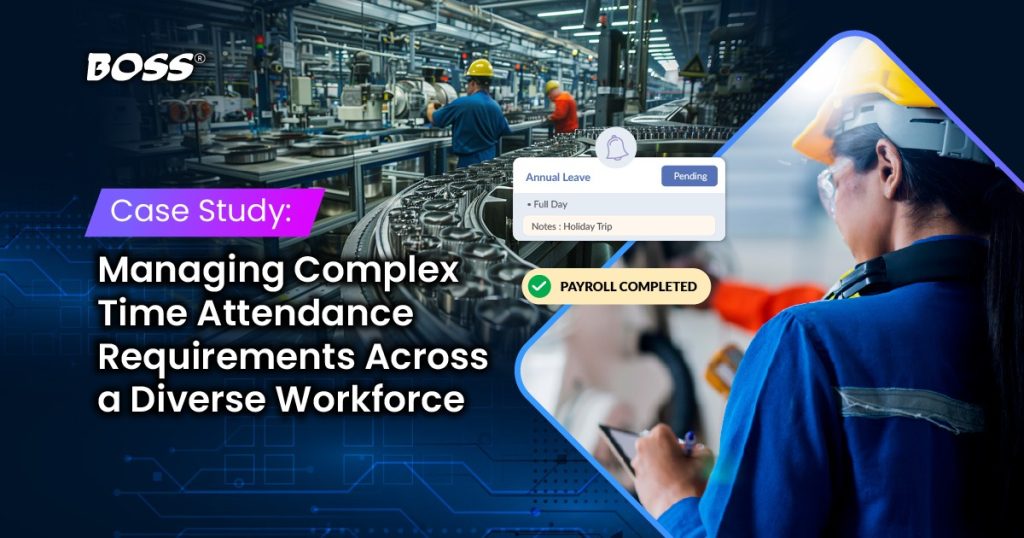
Many organizations view time attendance management as a straightforward process of recording employee clock-in and clock-out times. In reality, for businesses with diverse workforce structures and varying operational requirements, attendance management is far more complex. It is a critical business function that directly influences payroll accuracy, labour law compliance, workforce productivity, operational efficiency, and employee satisfaction.
The Challenge: One Workforce, Multiple Attendance Rules
This case involved an organization with a highly diversified workforce consisting of office employees, managers, sales personnel, warehouse staff, drivers, cleaners, site workers, and operational teams. Each employee group operated under different working arrangements and attendance policies.
While office employees followed standard working hours, operational staff worked on rotating shifts, flexible schedules, or roster-based arrangements. Overtime eligibility, break entitlements, attendance calculations, and payroll treatments varied significantly across employee categories.
As the organization expanded, managing these varying attendance requirements became increasingly challenging. The company needed to accommodate:
- Multiple shift patterns and rotating schedules
- Flexible working hour arrangements
- Roster-based workforce planning
- Different break and meal time policies
- Overtime eligibility and approval workflows
- Public holiday and rest day work calculations
- Attendance deductions for lateness and early departures
- Special arrangements such as Friday prayer breaks for selected employees
- Integration between attendance records and payroll calculations
The growing complexity made it difficult to manage attendance consistently while ensuring fairness and compliance across the workforce.
The Payroll and Attendance Connection
One of the most significant challenges was the close relationship between attendance data and payroll processing. Attendance outcomes directly affected employee earnings. Factors such as late arrivals, early departures, absences, overtime, public holiday work, and rest day attendance all influenced payroll calculations. For example, overtime payments could not simply be calculated based on total extra hours worked. In some cases, overtime hours needed to be adjusted against actual late-in or early-out records before payment could be determined. Employees operating under flexible working arrangements presented another layer of complexity. Instead of measuring attendance against fixed clock-in and clock-out times, attendance had to be assessed based on total hours worked within a specific period.
Additionally, different employee groups followed different overtime policies. Some employees qualified for overtime automatically based on attendance records, while others required managerial approval before overtime could be processed for payment.
These scenarios demonstrated that attendance management required much more than a basic time recording system. It required an intelligent rules engine capable of supporting multiple attendance scenarios while maintaining consistency and accuracy.
Business Risks of Ineffective Attendance Management
Without a properly configured attendance management system, organizations expose themselves to a range of operational and compliance risks. Payroll inaccuracies can result in employee overpayments or underpayments, creating dissatisfaction, payroll disputes, and additional administrative workload. Errors in overtime calculations or attendance deductions can also affect employee trust and confidence in the organization’s HR processes.
From a compliance perspective, inaccurate handling of working hours, overtime entitlements, public holiday compensation, and rest day work can lead to violations of labour regulations and potential financial penalties.
Operationally, many organizations attempt to bridge system limitations through manual calculations, spreadsheets, and exception handling processes. While these temporary measures may solve immediate problems, they often increase the risk of human error, delay payroll processing, and limit management visibility into workforce attendance patterns and labour costs.
Building a Sustainable Attendance Management Framework
To overcome these challenges, the organization undertook a comprehensive review of its attendance and payroll processes. The first step involved documenting and standardizing attendance policies across all employee categories. Attendance rules, overtime eligibility criteria, working hour arrangements, payroll impacts, and approval workflows were clearly defined and aligned with operational requirements.
Comprehensive system configuration and testing were then conducted to ensure all attendance scenarios were accurately processed. This included validating flexible working hour calculations, overtime rules, holiday work treatments, attendance deductions, roster schedules, and approval workflows.
Equally important was the seamless integration between attendance and payroll systems. By ensuring that attendance outcomes automatically flowed into payroll calculations, the organization significantly reduced manual intervention while improving payroll accuracy.
The Outcome
With a properly configured attendance management framework in place, the organization achieved greater control over workforce management while reducing administrative complexity. Attendance records became more accurate and transparent. Payroll processing became faster and more reliable. Compliance risks associated with working hours and overtime calculations were significantly reduced, while management gained better visibility into workforce utilization and labour costs. Most importantly, employees gained greater confidence that their attendance records and payroll calculations were being managed fairly and accurately.
Time Attendance Management as a Strategic Business Function
This case demonstrates that time attendance management is not simply an operational task—it is a strategic business process that requires alignment between HR policies, operational practices, compliance requirements, and payroll processes.
Organizations with diverse workforce structures need attendance systems capable of handling complex rules, varying work arrangements, and evolving business requirements. When implemented effectively, a modern attendance management solution can improve compliance, increase efficiency, strengthen employee trust, and provide valuable workforce insights.
By integrating attendance and payroll within a single platform, BOSS HRMS enables organizations to automate complex attendance calculations, improve payroll accuracy, strengthen compliance, reduce administrative effort, and gain better visibility into workforce performance and labour costs.