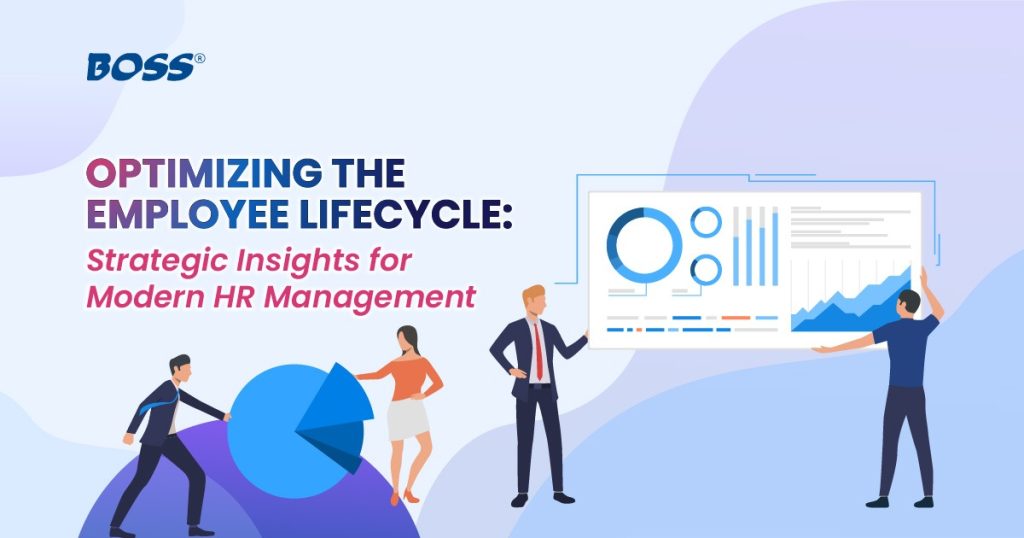
Every touchpoint along an employee’s journey—from their initial introduction to your brand until their eventual departure—profoundly shapes their organizational experience. Today, optimizing this journey is far more than an HR task; it is an essential business strategy. The most reliable vehicle to achieve this is a mature Employee Lifecycle Management (ELM) strategy. This guide unpacks the six core phases of the employee journey, offering actionable frameworks to maximize value for both your workforce and your operational success.
DEFINING THE EMPLOYEE LIFECYCLE
The employee lifecycle covers the entire timeline of an individual’s career within a company. It outlines every vital milestone and transition, including talent acquisition, onboarding, career growth, performance monitoring, and offboarding. For people leaders, understanding this journey is critical to building targeted strategies that boost output, foster long-term commitment, drive daily engagement, and systematically reduce turnover costs.
THE 6 CORE PHASES OF THE EMPLOYEE JOURNEY
1. Attraction
Long before an opening occurs, your company must stand out to premium talent. This phase relies on active talent sourcing and distinct employer branding to position your organization as a top-tier workplace where prospects can merge their personal aspirations with your business goals.
Employer Brand Equity: Build a stellar market reputation by highlighting your unique workplace culture, corporate values, and comprehensive benefits across job boards, digital networks, and your corporate website.
Sourcing Pipelines: Expand your candidate reach by leveraging professional networking events, internal referral incentives, and strategic digital outreach.
High-Impact Job Design: Write clear, professional job descriptions that balance key daily responsibilities with what makes your company a unique place to grow.
2. Recruitment
Once candidates enter your pipeline, the focus shifts to screening, interviewing, and selection. The goal is to identify individuals who possess the technical competencies required for the job and the cultural alignment needed to thrive long-term.
Strategic Job Placement: Publish detailed, transparent job descriptions on targeted platforms to align candidate expectations right from the start.
Data-Driven Screening: Use Applicant Tracking Systems (ATS) to screen resumes efficiently, verify baseline skills, and evaluate organizational fit.
Objective Interviewing: Conduct structured, behavioral interviews to objectively assess a candidate’s interpersonal skills, technical capabilities, and problem-solving style.
Offer Architecture: Manage professional offer extensions, lead transparent negotiations around salary and total compensation, and finalize employment agreements smoothly.
3. Onboarding
The onboarding phase bridges the gap between hiring a candidate and getting them fully operational. A structured onboarding program establishes early engagement, helping new hires adapt culturally while speeding up their time-to-productivity.
Welcome & Orientation: Provide structured overviews of company policies, introduce immediate teammates, and provision all hardware, software, and tools on day one.
Role-Specific Enablement: Deliver focused training built around immediate tasks and workflows. Pairing new hires with a peer mentor (“buddy”) helps them navigate their first few months with confidence.
Cultural Immersion: Help new team members internalize the company’s mission and behavioral norms to create a strong, early sense of belonging.
4. Development
Continuous professional growth is a pillar of long-term employee retention. By investing in your people’s advancement, you increase individual output, preserve institutional knowledge, and satisfy the modern workforce’s desire for upward mobility.
Performance Enablement: Establish regular, data-backed review cycles to offer constructive feedback, realign Key Performance Indicators (KPIs), and map out growth milestones.
Continuous Upskilling: Provide robust learning pathways, including internal training programs, professional certifications, and hands-on workshops.
Transparent Career Pathing: Map out clear internal progression frameworks so employees can easily visualize a viable, long-term career path within your company.
5. Retention
Retention strategies focus on keeping your current team members engaged, satisfied, and dedicated to the company long-term. Strong retention rates are a direct reflection of a healthy workplace culture and effective engagement practices.
Rewards & Merit Recognition: Build clear appreciation initiatives, spot awards, and formal recognition programs to celebrate high-performing employees.
Work-Life Integration: Promote operational agility by offering remote or hybrid work options, flexible scheduling, and practical corporate wellness programs.
Continuous Feedback Loops: Run frequent pulse surveys and focus groups to gauge team sentiment and address workplace concerns early.
6. Separation
The final phase of the journey occurs when an employee exits the organization through resignation, retirement, or contract completion. Handling this transition professionally protects your employer brand and corporate reputation.
Exit Diagnostics: Conduct formal, structured exit interviews to collect honest feedback, uncovering valuable insights to improve the environment for remaining staff.
Knowledge Preservation: Set up clear handover protocols to document critical workflows, maintain project continuity, and reallocate software licenses seamlessly.
Compliant Offboarding: Seamlessly handle final salary processing, statutory fund contributions, benefits closure, and IT access de-provisioning.
DIGITAL TRANSFORMATION: TOOLS FOR EVERY STAGE
Modern HR departments rely on specialized digital tools to automate administrative tasks, allowing teams to dedicate more time to strategic employee touchpoints.
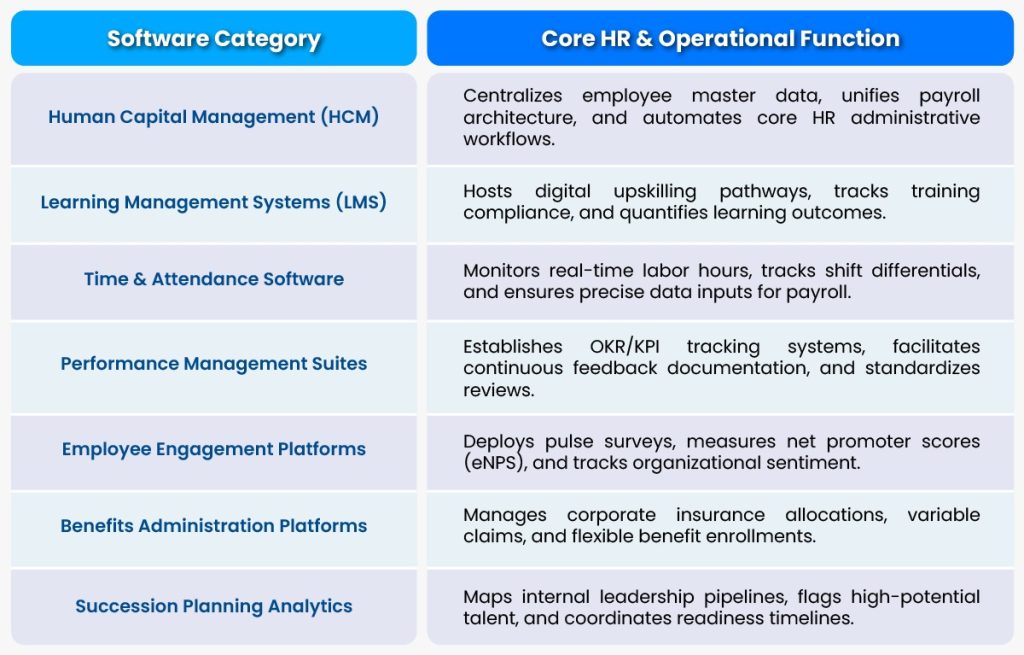
Human Capital Management (HCM): Centralizes master employee data, unifies payroll, and automates core HR processes.
Learning Management Systems (LMS): Hosts digital training pathways, tracks compliance, and measures learning metrics.
Time & Attendance Software: Monitors daily working hours, tracks shift rosters, and feeds accurate data to payroll.
Performance Management Suites: Tracks OKRs/KPIs, logs continuous feedback, and standardizes annual reviews.
Employee Engagement Platforms: Deploys pulse surveys, measures eNPS, and tracks workplace sentiment.
Benefits Administration Software: Manages insurance claims, flexible allocations, and benefit enrolment.
Succession Planning Tools: Identifies high-potential talent and manages internal leadership pipelines.
COUNTERING MACRO CHALLENGES IN LIFECYCLE MANAGEMENT
Managing a successful end-to-end employee lifecycle means proactively preparing for external market shifts. HR leaders can safeguard their organizations by implementing specific operational measures:
Navigating Economic Fluctuations: Financial changes pressure headcount and payroll budgets. HR leaders must build agile resource plans to maximize and optimize internal talent during market downturns.
Managing Rapid Tech Disruption: As digital tools evolve, skill gaps naturally widen. Address this by embedding automated upskilling tracks directly into daily workflows, ensuring your team adapts quickly to new tech.
Maintaining Regulatory Compliance: Staying aligned with changing labor laws, statutory fund caps, and tax rules can drain resources. Use cloud-based compliance systems and routine legal audits to eliminate compliance risks.
Sustaining a Dispersed Global Workforce: Managing global teams brings diverse cultural norms, multiple time zones, and fractured legal setups. Standardize decentralized operational policies and provide cross-cultural communication training for managers.
The employee lifecycle serves as an operational blueprint for talent optimization. By auditing and refining each stage—from attraction through to separation—organizations build a resilient, engaged, and loyal workforce. Creating a frictionless employee journey is the ultimate differentiator in driving sustainable, long-term corporate growth.