In today’s business environment, organizations are under constant pressure to improve productivity, maintain compliance, control labour costs, and enhance employee experience. While many companies focus on recruitment, employee engagement, and performance management, one fundamental process often determines the success of workforce operations: attendance management.
Employee attendance is more than simply recording when employees arrive and leave work. It directly influences payroll accuracy, overtime calculations, labour law compliance, workforce planning, operational efficiency, and employee trust. As organizations grow and workforce arrangements become increasingly complex, a reliable Time & Attendance Management System becomes essential for effective human resource management.
Understanding the Time & Attendance System
A Time & Attendance System (TAMS) is a solution that records, monitors, and manages employee working hours, attendance patterns, shifts, overtime, leave, and workforce schedules. The primary purpose of TAMS is to ensure that employee attendance data is captured accurately and translated into meaningful workforce information. Modern attendance systems not only record clock-in and clock-out transactions but also automate attendance calculations, apply company policies, manage shift schedules, and integrate directly with payroll systems.
A well-designed attendance management system serves as the bridge between workforce activities and payroll processing, ensuring employees are compensated accurately based on actual attendance records.
The Evolution of Tracking: From Paper to Biometrics
Organizations use various methods to track employee attendance depending on their operational requirements and workforce structure. Traditional attendance tracking methods include manual attendance registers, paper timesheets, and punch card systems. While these methods are simple to implement, they are highly dependent on manual administration and are prone to errors.
As businesses become more digitalized, many organizations have adopted electronic attendance tracking methods such as biometric fingerprint devices, facial recognition systems, RFID cards, mobile attendance applications, QR code check-ins, and GPS-enabled clocking systems.
Biometric technologies are particularly popular because they reduce attendance fraud such as buddy punching, where one employee clocks in on behalf of another. Mobile attendance solutions are increasingly used for remote workers, field staff, sales teams, and employees working across multiple locations.
Modern attendance management systems often support multiple attendance tracking methods simultaneously, providing organizations with flexibility while maintaining accurate attendance records.
The Corporate Imperative: Why Time & Attendance System is Crucial
Many organizations initially view attendance management as an administrative task. However, attendance data affects several critical business functions. Accurate attendance records form the foundation of payroll processing. Employee salaries, overtime payments, lateness deductions, unpaid leave calculations, public holiday compensation, and rest day payments all depend on accurate attendance information.
Attendance data also provides management with valuable insights into workforce productivity, absenteeism trends, punctuality issues, labour utilization, and staffing requirements.
For organizations operating multiple shifts, multiple locations, or large employee populations, manual attendance management becomes increasingly difficult to control. A proper attendance system enables businesses to standardize attendance policies, improve workforce visibility, and reduce administrative workload.
Most importantly, employees expect their attendance records to be accurate. When attendance information is managed correctly, employees gain confidence that their salaries and entitlements are calculated fairly.
The Invisible Drain: Challenges and Compounding Risks
| Core Challenge | Direct Risk to the Enterprise |
| Buddy Punching & Time Theft: Employees clocking in on behalf of absent colleagues. | Increased Labour Costs: Paying for thousands of hours of unperformed labor annually. |
| Manual Data Re-entry: HR teams manually transferring attendance data into payroll systems. | Human Error & Processing Delays: Calculation mistakes leading to payroll disputes, employee frustration and costly retroactive fixes. |
| Complex Shift Roster Disconnects: Managing multiple shifts and branches using spreadsheets or disconnected systems. | Operational Gaps & Burnout: Critical labor shortages on active production floors, alongside inadvertent breach of maximum legal working hours. |
Attendance management becomes significantly more complex as organizations grow. Many businesses manage diverse employee groups including office staff, managers, sales personnel, warehouse workers, drivers, technicians, security guards, and site-based employees. Each group may operate under different working hour arrangements, attendance policies, overtime eligibility rules, and shift schedules.
Organizations commonly face challenges such as:
- Multiple shift schedules
- Rotating rosters
- Flexible working hours
- Overnight shifts
- Split shifts
- Multiple clock-ins and clock-outs
- Overtime approval workflows
- Public holiday and rest day calculations
- Attendance exception management
- Multi-location workforce monitoring
In addition, hybrid work arrangements and remote working environments have introduced new attendance tracking requirements that traditional systems often struggle to support. The complexity increases further when attendance records must integrate directly with payroll calculations and statutory compliance requirements.
Organizations that rely on spreadsheets, manual calculations, or outdated attendance systems expose themselves to significant operational risks. Attendance inaccuracies can lead to payroll errors, resulting in employee underpayments or overpayments. These mistakes often create employee dissatisfaction and increase the administrative burden on HR and payroll teams.
Compliance risks are another major concern. Incorrect overtime calculations, excessive working hours, inaccurate public holiday payments, or improper rest day compensation may result in labour law violations and regulatory penalties.
Manual attendance processing also consumes considerable administrative resources. HR personnel often spend hours reviewing timesheets, verifying attendance records, resolving disputes, and performing payroll adjustments. Furthermore, management loses visibility into workforce productivity and labour costs when attendance information is fragmented or unreliable.
Ultimately, poor attendance management can negatively affect employee trust, operational efficiency, compliance, and business profitability.
The Importance of Automated and Intelligent Attendance Systems
Modern attendance management systems eliminate many of the challenges associated with manual attendance administration. By automating attendance calculations, organizations can significantly improve accuracy while reducing administrative workload. Attendance policies, shift rules, overtime formulas, break deductions, and payroll integration can be configured directly within the system.
An intelligent attendance system automatically applies company policies consistently across the workforce, minimizing human errors and ensuring fair treatment for all employees.
Real-time attendance monitoring enables managers to identify absenteeism, lateness, overtime trends, and staffing shortages more quickly. Automated approval workflows streamline attendance corrections, overtime requests, and shift changes.
Integration between attendance and payroll systems further improves efficiency by ensuring attendance data flows directly into payroll calculations without duplicate data entry.
Advanced attendance analytics also provide management with valuable workforce insights that support better planning, cost control, and decision-making.
Rather than functioning solely as a time-recording tool, intelligent attendance systems become strategic workforce management platforms.
Managing Workforce Attendance with BOSS’s Time & Attendance Management Sytem
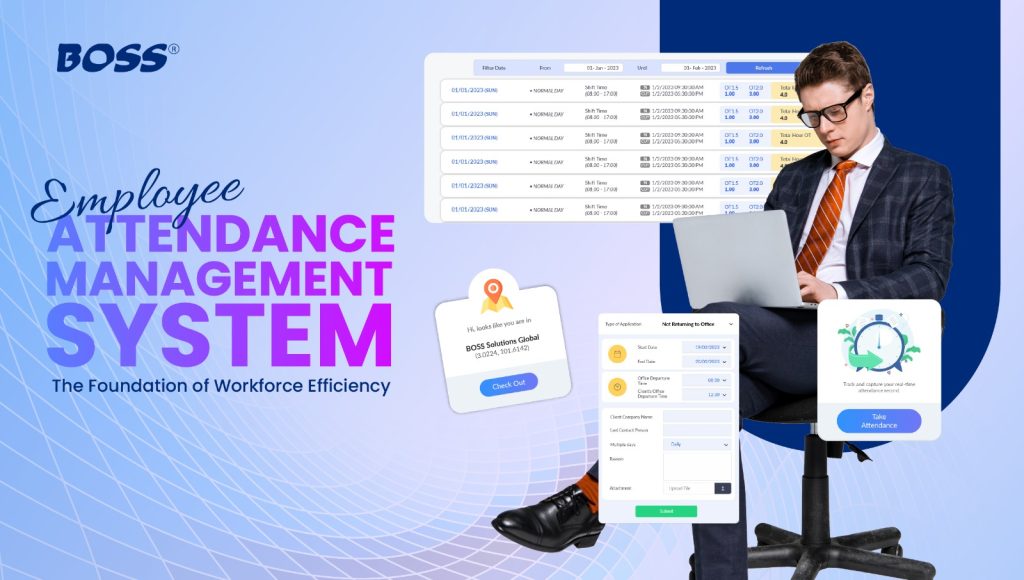
BOSS HRMS provides a comprehensive Time & Attendance Management solution designed to support organizations with diverse workforce requirements and complex attendance policies. The system supports multiple attendance tracking methods including biometric devices, mobile attendance applications, facial recognition technologies, and remote workforce clocking. It accommodates various attendance structures such as fixed schedules, flexible working hours, rotating shifts, roster management, split shifts, and overnight operations.
BOSS HRMS automates attendance calculations for overtime, lateness, early departures, public holidays, rest days, and attendance-based payroll adjustments. Organizations can configure company-specific attendance policies while ensuring consistency and accuracy across all employee groups.
The system integrates seamlessly with payroll, allowing attendance data to flow directly into salary calculations, overtime payments, statutory deductions, and payroll reporting. This eliminates duplicate data entry and significantly reduces payroll processing errors. Real-time dashboards and workforce analytics provide management with greater visibility into attendance patterns, labour utilization, absenteeism trends, and operational performance.
By combining automation, flexibility, compliance support, and payroll integration, BOSS HRMS helps organizations streamline attendance management, improve workforce efficiency, strengthen compliance, and build employee confidence.
Attendance management is no longer simply about recording employee working hours. It has become a critical business process that influences payroll accuracy, compliance management, workforce productivity, employee satisfaction, and operational efficiency.
As workforce arrangements continue to evolve, organizations require intelligent attendance systems capable of handling increasingly complex attendance requirements. Businesses that continue relying on manual processes face greater risks of errors, compliance issues, and administrative inefficiencies.
By adopting an integrated solution such as BOSS HRMS, organizations can transform attendance management from a routine administrative function into a strategic business advantage that supports growth, compliance, productivity, and employee trust.